Arlinda Gjypi (Kliko këtu për artikullin në shqip)
The number of people affected by cancer is growing to alarming figures. Indeed, according to the doctors, cancer will soon become the major cause of death in Albania, surpassing cardio-vascular diseases which are at first place for the moment. Despite the alarm, cancer patients are suffering due to lack of proper treatment and medicines, because they have to purchase their own drugs. Investigations have shown that they (cancer affected persons) usually buy drugs which have been smuggled in Albania.
Pharmacist Order’ President Diana Toma said for “Shëndet+” Newspaper (Health+) it is the lack of drugs in Albanian hospitals that encourages drug smuggling into the country. Based on this statement, “Shëndet+” Newspaper addressed the issue of cancer patients’ treatment to Mother Theresa University Hospital Center, asking for a thorough information on the last 6 years (2011-2016) regarding: the number of cancer patients, the budget required by Oncology Hospital, the allocated budget from the government and the responsibility this institution holds on the lack of cancer drugs.

Oncology Hospital
Patients: There is drug deficiency
Hysni Zhuli, whose wife is affected by breast cancer, says she just started chemotherapy and now their problems started too. “Drugs are a real trouble. Since we came for the first chemotherapy session, we’ve been told that some of the drugs are not in the hospital. They told us, we should purchase drugs by ourselves. Therefore, we asked other patients how did they deal with this, and they helped us find the necessary drugs”, says Zhuli. He emphasizes that nobody gives them a voucher for the medicines they buy. “No way to have a voucher. We go there in secret, as we are asking for an illegal drug, because we were told these medicaments are smuggled into the country. But there is no other way, we cannot find them differently. We need these drugs for the chemotherapy”, he adds. Zhuli showed us the “Adrimisin” drug he kept in his hands which is without fiscal stamp, which he bought in a pharmacy he was told by other patients to go.
Xhuljana Elmasllari is 19 years old and from Pogradec. “Doctors told me, I have tubercular glands in the lungs. After I did the first two chemotherapy sessions, I felt an improvement, but I couldn’t fully make the last chemotherapy due to lack of drugs. I cannot take even today’s chemotherapy, because there are no drugs at the Oncology Hospital.
Doctors gave me a prescription telling me I should buy the drugs if I want to undergo the next chemotherapy, because there are not drugs in the hospital. You can look at the prescription I got; my family cannot afford to buy these drugs. They cost 150.000 ALL for just one round of chemotherapy”, says Elmasllari.
Father of Ornela Dervishi, a cancer patient, also testifies on the drugs absence in the hospital and all problems their family is facing. “I bought all chemotherapy drugs from Turkey. Just a cycle of chemotherapy drugs costs 400.000 ALL, because you need 70.000 ALL for a session and there are five sessions for each round. But it doesn’t end here, because chemotherapy drugs are not the only thing we need. My daughter has a huge number of analyses she must do several times a year, and these analysis are done in private hospitals because the state hospital does not offer this service. Furthermore, doctors ask us to make all the analyses in the same lab together, not partially because this way they can better determine the problems. You see these analyses I just did? I could not afford to make all of them, because they would cost me 126.000 ALL and I can’t afford this amount of money. It is very expensive. All cures, analyses and chemotherapy sessions are very expensive and we don’t know how to deal with this”.

Oncology Hospital answer
Cancer patients’ number increases dramatically
Information provided by Mother Theresa University Hospital Center (QSUT) reflects an alarming and scary figure of cancer affected people.
The following is an official chart which shows the huge increase of cancer affected people in the last years. While the time period 2011-2013 includes figures from other hospitals in Tirana, apart from Mother Theresa University Hospital Center (QSUT), the figures of 2014 and 2015 have been taken from the Oncology Hospital only. Thus, it is proven that from 2014 to 2015 there is an increase of 56.9% of cancer patients, while in numbers the increase is from 3286 to 5158 patients, which shows the immediate need of increasing state budget for this category.
| Time Period | Number of cases |
| 2011 | 3317* |
| 2012 | 3619* |
| 2013 | 3936* |
| 2014 | 3286 |
| 2015 | 5158 |
*) Years 2011-2013 include the number of new cases of tumor diseases in all hospitals including QSUT, Trauma Hospital, Pulmonary Diseases Hospital and 2 Maternity Hospitals in Tirana.
Oncology Hospital answer
Patients’ number increases, state drug budget decreases
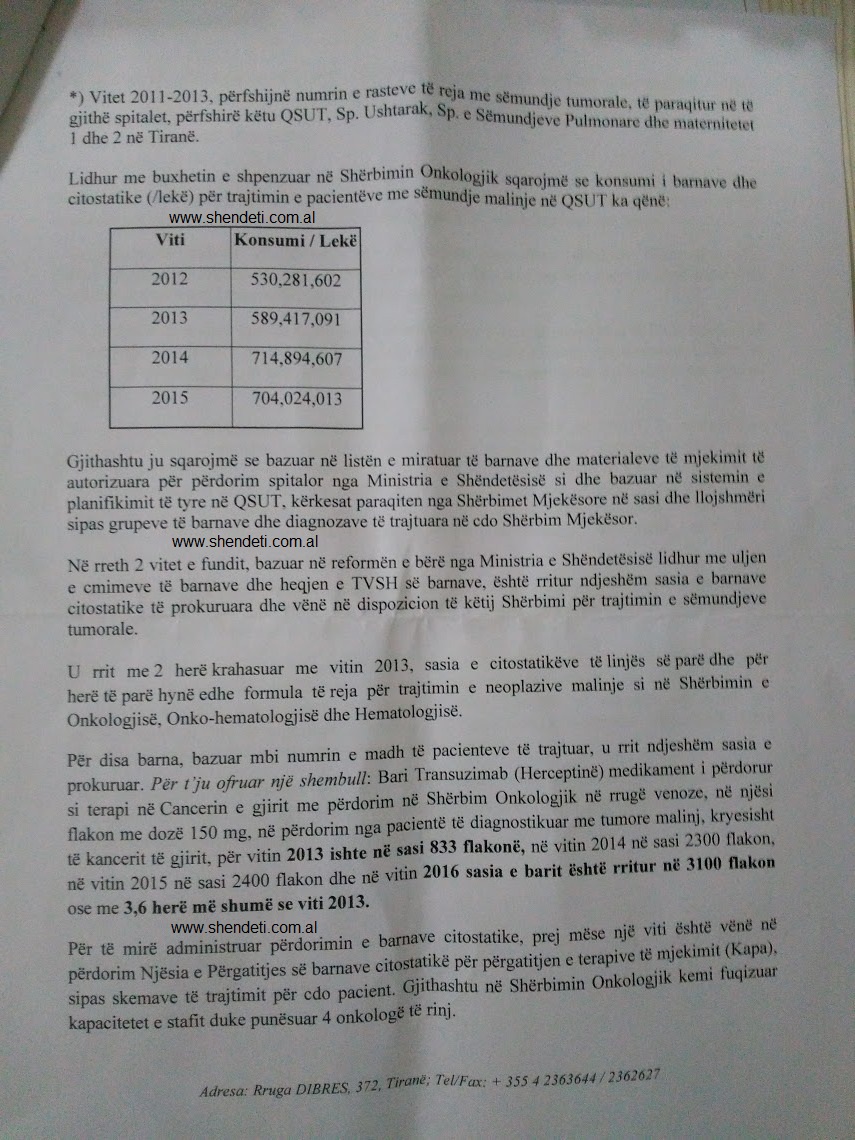
“Shëndet+” (Health +) Newspaper requested Mother Theresa University Hospital Center (QSUT) for information about state budget on cancer patients for time period 2011-2016, but the institution provided us with the budgets of 2012-2015. At first survey of the figures, you notice the budget has increased from year to year, but compared to the patients’ number it is quite evident the budget has significantly decreased. Therefore, what is obvious but incomprehensible is the fact that patients number from 2014 to 2015 increased by 56.9%, while the budget on the same time period, decreased by 1.5 % as the following chart shows.
| Year | Budget in ALL |
| 2012 | 530.281.602 |
| 2013 | 589.417.091 |
| 2014 | 714,894,607 |
| 2015 | 704,024,013 |
Drastic increase of cancer cases, ridiculous drugs supply
Regarding the budget decrease for 2015, the directory of Mother Theresa University Hospital Center (QSUT) was excused saying that in the last two years (including 2016) based on the reform achieved by the Ministry of Health on drugs’ prices decrease and lifting the VAT, the hospital has increased the quantity of procured cytostatic drugs for the Oncology service and the treatment of tumor diseases.
In order to show “the significant increase” the procured quantity of drugs, the QSUT directory offers this example: “Regarding Transuzimab (Herceptine) the medicament used as a therapy for breast cancer in the Oncology Service in 150 mg flacon for malignant tumor diagnosed patients, we had a supply of 833 flacons in 2013, 2300 flacons in 2014, 2400 flacons in 2015 while the number has increased to 3100 flacons for 2016, therefore 3.6 times more compared to 2013”.
Taking for granted what the QSUT directory states, we would say there is a drugs increase for every patient. But figures show that cancer patients at the Oncology Service have increased from 2014 to 2015 with 56.9% (from 3286 to 5158). Meanwhile the flacons quantity for Herceptine (Transuzimab drug) increased by 4.34%, (from 2300 to 2400 flacons). The figures show that there is indeed a drastic decrease of drugs supply from 2014 to 2015 for cancer patients. Meanwhile the increase pretended by QSUT directory for 2016 compared to 2013 in reality is a decrease of drugs supply. Explained in figures, in 2014 this medicament was ensured for around 70 % of patients, while in 2015 the drug was ensured only for 46.5% of the patients. Therefore, this is a decrease of 20% of the Herceptine drug supply.
| Time period | Number of cases | Trasuzimab (Herceptine) |
| 2013 | 3936* | 833 |
| 2014 | 3286 | 2300 |
| 2015 | 5158 | 2400 |

Oncology Hospital answer
QSUT is not aware of patients’ destiny
Mother Theresa University Hospital Center’ directory didn’t accept to answer on the question how does the institution cover drugs needs which are not ensured by the state budget. The directory also didn’t provide us with figures on the budget demand made by the Oncology Service for the period 2011-2016.
Meanwhile regarding the register which should provide statistical evidence for Oncology Service effectiveness, QSUT directory replied: “In order to assess the effectiveness of patients’ treatment at the Oncology Service, we clarify that the basic mechanisms of following diseases progress is patients’ medical record, approved by Ministry of Health. Partial information regarding patients’ performance and drugs’ effectiveness are also published in oncology specialists’ studies in different science magazines, which you can find at Faculty of Medicine”.
This shows that QSUT is not aware of the results achieved by the treatments offered at the Oncology Service.
QSUT: Patients choose themselves to by drugs out of the hospital
Investigations made by “Shëndet+” newspaper prove that a good part of the patients undergo chemotherapy sessions with drugs they privately purchase due to lack of medicament at the Oncology Hospital. Meanwhile many cancer treatment drugs do not have the required stamp from the National Center of Drugs Control. Nevertheless patients purchase these drugs and give them to the doctors to ensure their treatment, due to lack of medicament in the hospitals.
Asked why QSUT allows these drugs inside hospitals and what its responsibility is, the institution answered that this is a patients’ choice. “Regarding your question, we clarify that there is a patients’ category that choose to undergo treatments in the hospital with drugs they privately purchased, which is allowed by the Oncology Service regulation, according to a specific procedure.
“The National Agency of Drugs and Medical Supplies is the institution which approves which drugs can enter into the Albania’s territory while it monitors the quality of drugs traded in the public and private healthcare system”.
The response proves that QSUT considers it a “patients’ choice” to purchase the drugs out of the hospital, and not a constraint due to lack of medicament in the Hospital Center. National Drugs Center gave the same response to our question regarding smuggled drugs purchased by cancer patients, stating that “citizens should be careful when they purchase uncontrolled medicament”.
As for state responsibility, which according to legislation, should provide all patients with necessary medicament and not oblige them to purchase drugs out of hospitals, neither Mother Theresa Hospital University Center, nor the National Center of Drugs Control do not take any responsibility.