Denisa Canameti, “Shëndet+” newspaper (Kliko këtu për versionin shqip)
Longtime years waiting for an operation that the state should guarantee for free, but in reality it doesn’t accomplish. This is the bitter truth of all children who are born with hearing problems and must undergo the cochlear implant. Their parents wait for years while children grow up and after 7 years old they don’t have any hope.
 60-70 children are born every year in Albania with hearing problems. A cochlear implant is an electronic medical device that replaces the function of the damaged inner ear for all people with severe loose of hearing or deep one (neural deafness). Regardless this intervention is on the list of treatments 100 % reimbursed by the state, its application hasn’t started yet.
The head of Otolaryngology service at Mother Teresa University Hospital Center, Besim Boçi, said everything is ready and they have already evaluated all necessary costs but the project hasn’t been implemented yet.
While the Ministry of Health says this is the Healthcare Mandatory Insurance Fund’ responsibility, the Fund itself says it only finances the chirurgical procedure of installing the cochlear implant, but it is the Ministry’s responsibility for guarantying the devices according to EU standards.

The testimonial: I waited 4 years for the operation, than I took a loan of 20.000 Euros and made the operation at a private hospital
Borjana P. is the mother of a 5 years old girl, who was born deaf as many other children in Albania. She went initially to the Otolaryngology department at Mother Teresa University Hospital Center to ask for a cure. Borjana tells us on the family longtime meanders at Mother Teresa University Hospital Center’s doors. But time is an important factor for all similar cases. The intervention should be done before the child becomes 7 years old.
“I’m the mother of a child who was born deaf. I went to Greece where my daughter went through an intervention after I waited for 4 years waiting for anyone to help. We even tried our connections through politicians but we couldn’t achieve anything. So we took a loan at the bank for 20 thousand Euros. So my family has now a debt of 20 thousand Euros but at least we won the most important thing, our daughter can hear”, says sadly Borjana.
Doctor Besim Boçi: The cochlear implant, a project remained in paper
The head of Otorhinolaryngology Department at Mother Teresa University Hospital Center, Besim Boçi,
Dr. Besim Boçi
says it is true that the cochlear implant is part of reimbursed treatments by the state, but till now hasn’t been applied. It remained a project in paper. Boçi adds he doesn’t know where the project has stuck.
“I don’t understand what the obstacles are. We have already evaluated costs but now I don’t understand why it’s not starting. If we don’t offer the implant, there is no point in choosing patients”-says Boçi. He emphasized that this situation has put doctors at Otolaryngology department under a big pressure. “Many families come here yelling at us, asking to be on the list. Meanwhile the procedure hasn’t even started. Here I have the waitlist, but it doesn’t change anything. The intervention will not be done”-says Boçi.
Mother Teresa University Hospital Center: We have the necessary infrastructure
At the other hand, the management of Mother Teresa University Hospital Center says that Otolaryngology service has the necessary infrastructure to achieve interventions for the cochlear implant. But they added we should ask for further information at the offices of Healthcare Mandatory Insurance Fund.
The Ministry of Health: Ask the Healthcare Mandatory Insurance Fund
As the main institution for this issue, we went to the Ministry of Health to ask what its responsibilities are for not applying the cochlear implant project and also about the purchase of all necessary devices for this intervention.
The official answer from the Ministry of Health was: “The contractual and responsible authority for monitoring all service packages implementation (including the cochlear implant) is the Healthcare Mandatory Insurance Fund, therefore you should ask for information near this institution”.
So at the end, the Ministry of Health passed over its responsibility to Healthcare Mandatory Insurance Fund, although it doesn’t say anything about the purchase of necessary equipments, without which the cochlear implant cannot be achieved.
Healthcare Mandatory Insurance Fund: The Ministry of Health should guarantee the devices
Healthcare Mandatory Insurance Fund states that it finances the chirurgical procedure but the implant should be guaranteed by the Ministry of Health.
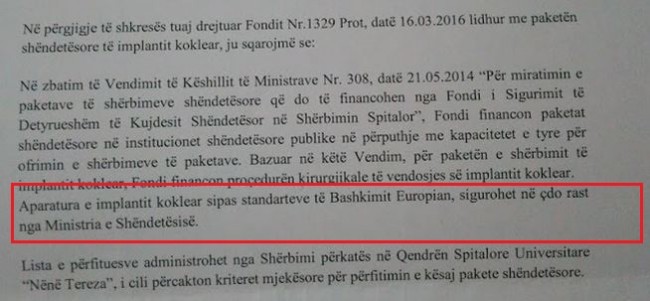
The answer of the Fund: The devices must be ensured by Ministry of Health
Below is the full answer of the Fund:
“In accordance to the Decision of the Council of Ministers Nr.308, date 21.05.2014 “For the approval of healthcare service packages that will be financed by Healthcare Mandatory Insurance Fund at Hospital Service”, it is the Fund who finances healthcare packages at public healthcare institutions according to their abilities to offer these services. Based on this decision for the cochlear implant package, it is the Fund who finances the chirurgical intervention. The cochlear implant device according to European Union standards is ensured in any case by the Ministry of Health”.
Cochlear implant, the only solution for children with hearing problems
Edlira Beqiri, a doctor pediatrics and otolaryngologist at the infantile chirurgic service explains how born deafness makes the highest rate congenital pathology compared to all other birth illnesses in the population.
“Testing since birth is very important to diagnose in early stage the hearing loss, because this is the only way to prevent severe damages this pathology carries in the child’s life, regarding the inability for a normal lingual development”-says Beqiri.
According to the doctor, the contemporary technological progress has made possible to achieve the Universal Neonatal Hearing Screening which enables doctors to discover permanent hearing loss of the newborns.
“For the first time in our country’s history, we applied a project of universal screening in the beginning of 2009. This project was supported by an Italian team of audiologists and logopedist doctors at University of Modena, Padua and Reggio Emilia. The project was meant to cover all births in three main cities: Tirana, Shkodër and Fier with a birthrate of 17 thousand children a year. Our country natality rate is between 30-35 thousand births a year. At the end of the project, we evaluated that born deafness rate is 2.1 children in 1000 (one thousand) births. This means that every year 60-70 children are born with hearing problems. The cochlear implant is the only intervention that enables hearing for newborns”.